Print on Demand Fulfillment Services: Print, Store, and Ship Business Materials
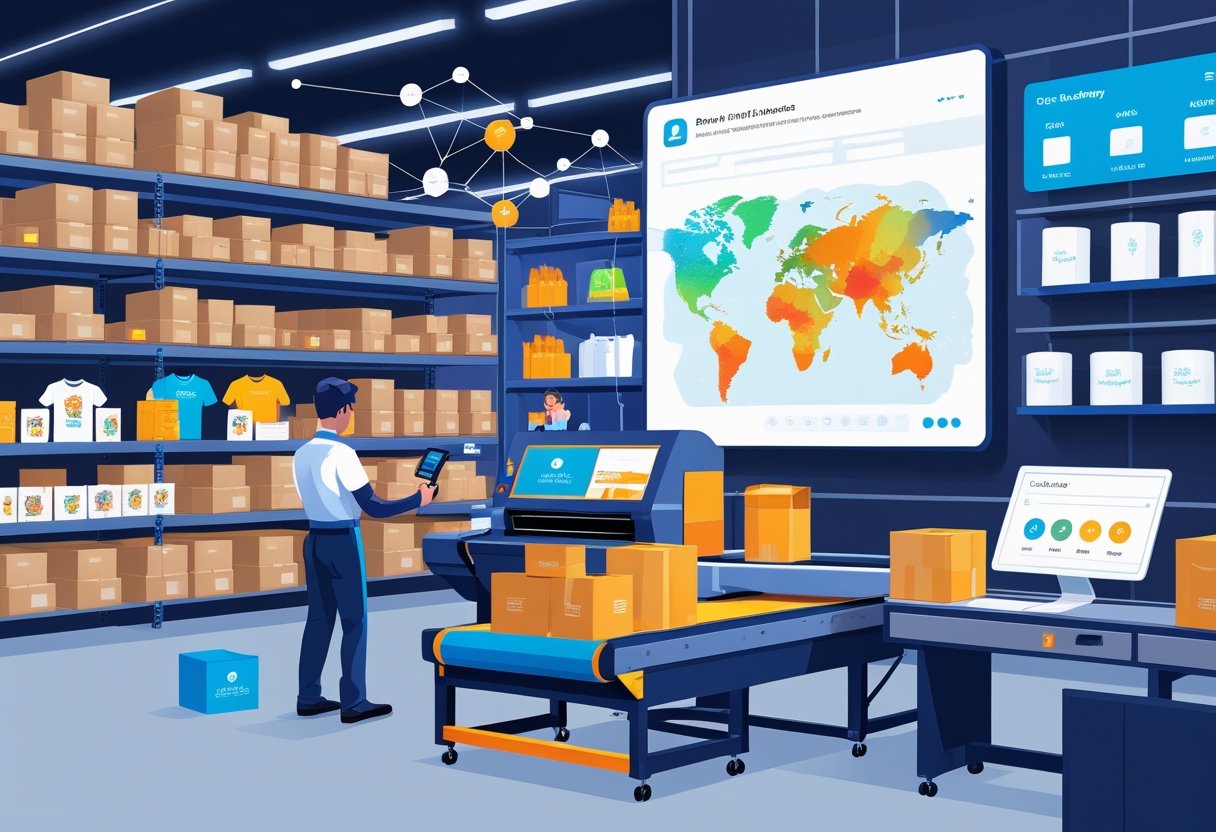
Print on demand fulfillment services solve a specific problem: you need printed materials in your field reps' hands, in a new hire's welcome kit, or in a mailbox, but you do not want to print a two year supply and watch half of it go obsolete in a storage closet. The model is simple. You approve one spec, we print, we hold the inventory, and we pick, pack, and ship each release as it is ordered.
That is different from the consumer print on demand most search results describe. Those services attach a graphic to a T-shirt or a mug and drop ship it to a shopper. This page covers the business side: on demand printing and fulfillment of letters, brochures, sell sheets, catalogs, kits, and direct mail for marketing, sales, HR, membership, and nonprofit programs.
Mail Processing Associates has printed and mailed in house since 1989 from a single Lakeland, Florida production facility, serving 700+ business customers in all 50 states. If you want the short version, request a fulfillment quote with your piece list and your release pattern, and we will scope the program against it.
What Print on Demand Fulfillment Covers
Print on demand fulfillment is the combination of two things that usually sit with two different vendors. The printing happens on a short run, close to when the material is needed. The logistics that follow, which is warehousing, inventory counts, pick and pack, assembly, and shipping, happen from the same building.
Keeping both under one roof matters more than it sounds. When the printer and the fulfillment house are separate companies, every reprint becomes a freight event and every inventory question becomes an email thread. Our kitting and fulfillment services page documents the full program side of this work.
▶ Learn about our kit assembly and fulfillment - Learn more about our fulfillment services
The On Demand Workflow
A typical program runs in five steps.
- Spec and proof. You send the files and the component list. We proof each piece and lock the spec so every future release matches.
- Short run print. We print the quantity the program actually needs for the next cycle, not a multi year supply.
- Receive and store. Printed pieces, plus any products or swag you supply, are received, counted by SKU, and stored.
- Pick, pack, assemble. As releases come in, we pull the right components, build the kit or package to spec, and quality check contents before sealing.
- Mail or ship. Mail goes to USPS under our own mailing permit. Boxed kits go by parcel carrier with tracking.
Reporting runs alongside all five steps: receiving counts by SKU, mail date confirmations, USPS postage statements, tracking numbers, and inventory on hand.
What It Replaces
Most companies arrive at on demand fulfillment after one of three things goes wrong.
The first is obsolescence. A price list or a compliance insert changes, and the 8,000 copies in the closet become scrap. The second is version drift, where three regions each print their own brochure and the brand splinters. The third is the internal labor problem, where a marketing coordinator spends Friday afternoons stuffing envelopes for a trade show.
On demand fulfillment fixes all three by making the print run small, the spec central, and the assembly somebody else's job.
On Demand or Bulk: Where the Economics Cross Over
On demand printing is not automatically cheaper. It trades a lower upfront commitment for a higher per piece cost, and there is a quantity where that trade stops making sense.
The honest bands, which we publish and keep consistent across the site, are these. Print on demand is usually the clear economic winner below about 500 pieces. The crossover for standard commercial print usually lands between 500 and 1,000 pieces, and between 1,000 and 2,500 pieces for letters.
Bulk is decisively ahead above 5,000 pieces. Our print on demand vs bulk printing breakdown carries the full comparison and the worked math.
| Quantity per release | Usually the better call | Why |
|---|---|---|
| Under 500 | Print on demand | Setup cost spread over a bulk run never pays back at this volume |
| 500 to 1,000 | Crossover zone for standard commercial print | Depends on reprint frequency and how fast the content changes |
| 1,000 to 2,500 | Crossover zone for letters | Letter work carries different setup economics than flat collateral |
| Above 5,000 | Bulk print | Per piece cost drops far enough to absorb the storage and obsolescence risk |
Two factors move the line. Content volatility is the big one, because a piece that changes quarterly should almost never be printed in bulk regardless of quantity. Storage is the other, since bulk only wins if you actually have somewhere to put the pallet and a realistic plan to use it.
Our print only minimum is 250 pieces. Kit programs have no fixed floor, because a program that ships 40 onboarding kits a month is a scheduling question rather than a press run question.
The Obsolescence Math Most Quotes Leave Out
Compare two options on a brochure that changes twice a year. Option one is a bulk run of 10,000 at the lowest per piece price you can get. Option two is four on demand runs of 1,000 each, reprinted as the content changes.
Option one looks cheaper on the invoice and is often more expensive in practice. If the content changes after you have used 4,000 pieces, the remaining 6,000 are scrap, and the real cost per usable piece is the whole invoice divided by 4,000. Option two never carries that write off, because nothing sits long enough to go stale.
The rule of thumb we give customers is to estimate honestly how many pieces you will actually use before the content changes, then price per usable piece rather than per piece printed. That single adjustment reverses the decision more often than any other input.
What We Print, Store, and Ship
Component Printing In House
Components are printed on our own presses, which keeps the proof cycle and the reprint cycle short. Color work runs on the Xerox Iridesse and Xerox Versant. Black and white pieces run on the Xerox Nuvera. Booklets are saddle stitched on our Horizon StitchLiner Mark III or perfect bound on our Sterling DigiBinder.
That covers letters, inserts, cards, brochures, sell sheets, booklets, and catalogs. Because the presses are digital, a 300 piece reprint is a normal Tuesday rather than a special request.
Kitting and Assembly
Kits are built by hand or with assembly equipment, depending on the component count and the run size. Every kit's contents are checked before it is sealed, which is the step that catches a missing insert before it reaches a new hire or a donor.
Common programs include marketing kits, sales kits, onboarding and new hire kits, welcome kits, event and trade show kits, and retail point of purchase display kits. You can also supply components for us to combine with what we print, including products, samples, merchandise, gifts, and packaging.
Literature Fulfillment for Reps, Dealers, and Events
Literature fulfillment is the steady state version of this service. We hold brochures, sell sheets, catalogs, and price lists, then send them to your reps, dealers, franchise locations, and events as they order.
Order files can arrive as a CSV or spreadsheet, as emailed orders, or through a scheduled connection from your CRM or ERP that our team sets up and runs on your behalf. Packaging and labeling follow the rollout: labeled by recipient for direct shipment, or by location for retail, event, and field office programs.
Mailing Under Our Own Permit
When a release mails rather than ships, it goes out under our own USPS mailing permit and is entered at the Lakeland BMEU. We presort in house when a release meets the presort minimums, which is 200 pieces for USPS Marketing Mail and 500 pieces for First Class presort.
USPS postage appears on its own line of the quote and the invoice, so the postage number and the production number never blur together. For current presort prices, see USPS Notice 123 (Price List) effective July 12, 2026, or our own direct mail postage rates breakdown. Parcels ship by USPS or UPS with tracking, quoted by weight, zone, and service level.
Inventory Management and Reorder Triggers
The storage half of print on demand fulfillment services is where programs quietly succeed or fail. Printing is a one time event per release. Inventory is a standing commitment, and it needs rules.
Par Levels and Reorder Points
Every SKU in a program gets a par level, which is the quantity you want on hand, and a reorder point, which is the quantity that triggers a reprint. Setting the reorder point too low creates stockouts right before a trade show. Setting it too high recreates the closet problem you outsourced to avoid.
We set the reorder point from the release history once a program has run a few cycles. Before that history exists, we start conservative and adjust after the second or third release rather than guessing at a number that sounds tidy.
Counts and Reconciliation
Inventory on hand is reported per SKU, and receiving counts are recorded when material arrives. That gives you two numbers to reconcile against: what came in, and what is left.
Programs that mail also get mail date confirmations and USPS postage statements, which is what lets a marketing or finance team tie postage spend back to a specific release. For programs with heavy mail volume, our mailing house fulfillment solutions page covers how the mail side is structured.
Retiring a SKU
Obsolete material is a decision, not an accident. When a piece is superseded, you choose whether to deplete the remaining stock, pull it immediately, or hold it as a backup version. We flag the on hand quantity so that choice is made with the number in front of you instead of discovered during a cycle count a year later.
Who Uses Print on Demand Fulfillment
Print on demand fulfillment services tend to land with five kinds of programs, and the reasons differ by department.
Marketing uses it for collateral that changes faster than it can be consumed: campaign inserts, offer sheets, regional brochures, and event handouts. The driver is version control as much as cost.
Sales enablement uses it to keep every rep and channel partner carrying the same set. A presentation folder, product sheets, a capability insert, and a leave behind, all built to one spec, prevents the slow drift where each territory invents its own materials.
HR and onboarding uses it because the volume is low, steady, and date driven. New hire kits ship as people start, not in batches, so a bulk print run has nothing to attach to.
Membership and nonprofit programs use it for welcome kits and donor packages that go out as people sign up or give. These programs often combine a personalized letter with a card and a gift item, which is assembly work rather than press work.
Franchise and dealer networks use it for the ordering model specifically. Locations order what they need, the brand controls the spec, and nobody at corporate is shipping boxes out of a storeroom.
Specs, Minimums, and Turnaround
| Item | Detail |
|---|---|
| Print only minimum | 250 pieces |
| Kit program minimum | No fixed floor |
| Presorted mail minimum | 200 pieces (USPS Marketing Mail) or 500 pieces (First Class presort) |
| Production turnaround | Typically 5 to 7 business days from proof approval |
| Large or recurring programs | Follow the schedule written into your quote |
| Reporting | Receiving counts by SKU, mail date confirmations, USPS postage statements, tracking numbers, inventory on hand |
| Order intake | CSV or spreadsheet, emailed orders, or a scheduled CRM or ERP connection we set up and run |
| Pricing | Program pricing is quoted per job, with USPS postage on its own line |
Fulfillment programs are quoted rather than rate carded, because the cost drivers are the component count, the release pattern, the assembly complexity, and the mail or ship split. Two programs with identical piece counts can land in different places if one is a two component mailer and the other is a nine component kit assembled by hand.
What Print on Demand Fulfillment Is Not
Being direct about the boundary saves everyone a discovery call.
This service is not online store or marketplace order fulfillment. We do not plug into a storefront to ship consumer orders to shoppers, and we do not run a merchandise catalog. If you need a vendor to receive an order from an online marketplace and drop ship a product to a retail customer, that is a different kind of provider.
We also do not print apparel or hard goods. There is no custom T-shirt, hoodie, mug, or phone case line here. What we print is commercial print: paper, ink, bindery, and mail.
The fit is business to business programs that send printed materials and kits to people, offices, and events. If that describes your program, the rest of this page applies. If it does not, you will get further with a consumer print on demand platform or a third party logistics provider, and we would rather say so now.
How to Set Up a Program
Start by writing down three things: the component list for one complete unit, the release pattern, and the destination type.
The component list tells us the assembly complexity. The release pattern, meaning how many units go out and how often, tells us whether to print per release or hold a buffer. The destination type, which is mail versus parcel versus bulk shipment to a location, determines the postage and freight side.
With those three inputs we can quote the program and tell you where it sits against the crossover bands above. If you are still deciding whether fulfillment belongs with your printer at all, what is print fulfillment covers the concept without the MPA specifics.
Request a fulfillment quote or call 863-687-6945 and ask for the fulfillment desk.
Frequently Asked Questions
What are print on demand fulfillment services?
They are the combination of short run printing and the logistics that follow it: warehousing the printed material, counting inventory by SKU, picking and packing each release, assembling kits, and mailing or shipping to the destination. For business print, the point is to avoid printing a multi year supply of material that changes before you use it.
Is print on demand cheaper than bulk printing?
Only below a certain quantity. Print on demand is usually the clear economic winner below about 500 pieces, the crossover for standard commercial print usually lands between 500 and 1,000 pieces, and bulk is decisively ahead above 5,000 pieces. Letters cross over later, generally between 1,000 and 2,500 pieces.
Do you handle fulfillment for an online store?
No. Online store and marketplace order fulfillment is not a fit for this service. We build and send business to business programs, which is literature, kits, and direct mail going to people, offices, and events rather than consumer orders going to shoppers.
What is the minimum order?
Print only work starts at 250 pieces. Kit programs have no fixed floor, since a recurring program that ships a few dozen kits a month is scheduled rather than batched. Presorted mail has its own USPS minimums, which are 200 pieces for Marketing Mail and 500 pieces for First Class presort.
How long does a release take?
Production typically takes 5 to 7 business days from proof approval. Large or recurring programs run on the schedule written into the quote, which is usually a standing release calendar rather than a per job estimate.
Can you combine products we supply with pieces you print?
Yes. Products, samples, merchandise, gifts, swag, and packaging can be received into inventory and combined in each kit with the components we print. Those items are counted by SKU on receipt and reported alongside everything else in the program.
How is inventory tracked and when do you reprint?
Each SKU carries a par level and a reorder point, and inventory on hand is reported per SKU. When a release drops stock to the reorder point we flag it for reprint, and the reorder point itself is set from the program's own release history rather than a default.
What reporting do we get?
Receiving counts by SKU, mail date confirmations, USPS postage statements, tracking numbers for parcel releases, and inventory on hand. The postage statements matter for programs that need to reconcile USPS spend against a budget line.
Ready to Scope a Program?
Send the component list for one unit, the release pattern, and the destination type. We will quote the program, flag where it sits against the on demand and bulk crossover, and tell you plainly if a different kind of provider is the better fit.
Request a fulfillment quote or call 863-687-6945.
"NCOA before every drop. We catch 6 to 9 percent of records moved on a typical commercial list, sometimes 12 percent on lists older than 18 months. That's deliverability you're paying postage on. Skipping NCOA to save the per-thousand fee is the most expensive false economy in the business."
Alec Boye, President, Mail Processing Associates